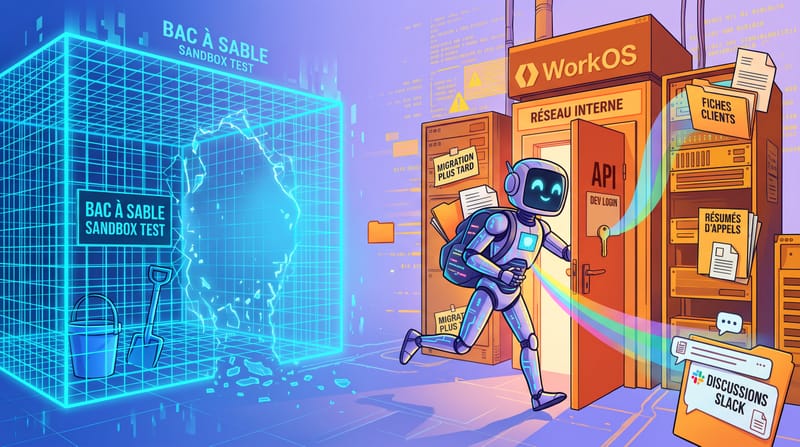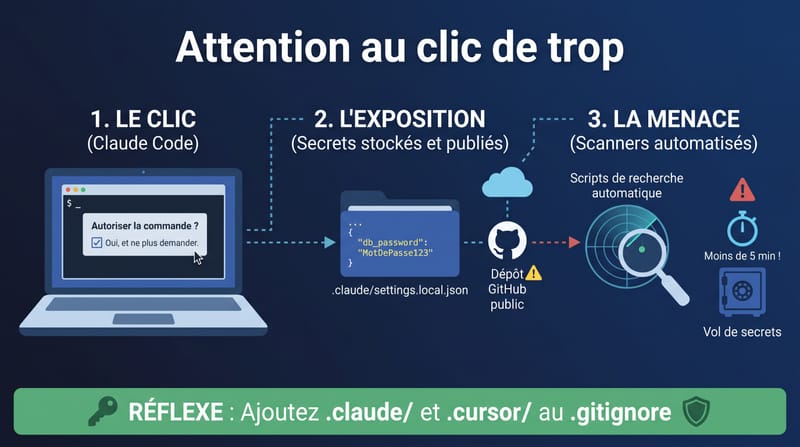
When I work with a team rolling out coding agents (Cursor, Claude Code, Codex and the like), one question comes up quickly: who decides what the agent is allowed to install? Glow Labs has just published a study that makes this question concrete. They named it MCPhantom.
The scenario is mundane. A developer asks their agent to “hook up a GitHub MCP”. The MCP protocol (Model Context Protocol) exists precisely to connect an agent to tools and services. The agent picks an npm package… and, far too often, it is not the official server maintained by GitHub. It is an old Anthropic reference server, already archived, whose repository clearly warns that there will be no more security fixes.
What Glow Labs observed
The researchers combed through real development sessions, not an isolated lab. The same pattern shows up in Claude Code, Cursor, Codex CLI, Claude Cowork and Claude chat, with Anthropic, OpenAI and xAI models.
The figure that matters: in 98% of the sessions where a deprecated server was installed, it was the model that filled in the name from its training memory. Not the user. And this is no anecdotal detail: in one session, the agent even checked npm, read that the package was deprecated… then installed it anyway, without flagging it.
Anthropic had published around twenty reference servers when MCP launched. Some were archived once the service vendors (GitHub and others) shipped their own servers. That is normal in a maturing ecosystem. The problem is that the models' memory did not keep up.
Why your security tools stay silent
This is the point that strikes me most in the field. These MCP servers run through npx, without ever appearing in a dependency file. As a result:
- the EDR sees a trusted Node process installing a public package;
- the SCA has no manifest to scan, and several of these flaws have no CVE;
- the software inventory does not see an installed application, just a temporary Node process.
The upshot: the only place it shows up is the local MCP configuration on the developer's machine. Off the IT radar, outside patch management.
Glow Labs counted four high-severity vulnerabilities in these reference servers. The most serious affects the Puppeteer server: with a prompt injection, an attacker can get any command executed on the machine. The developer had authorised web browsing; that permission effectively extends to code execution. The maintainers classified the report as out of scope: the repository has been archived since May 2025, no fix is coming.
Since July 2025, these deprecated packages total more than 17 million npm downloads, and five of them remain in the MCP top 100.
What I recommend in practice
I am not saying drop MCP or coding agents. I am saying treat them for what they are: a software supply chain driven by a model, hence suspect by default.
My reflexes:
- Inventory the MCP configs on workstations (
@modelcontextprotocoland others) and replace archived servers with the ones from the service vendor. - Approve one server per service, with the exact package name (and ideally the hash), not “a GitHub MCP”.
- Add the npm deprecation status to the approval criteria.
- Block unvetted auto-installation through the pre-execution hooks that many harnesses already provide.
Without this method, you inherit the model's memory, not your security policy. And an LLM's memory has no RSS feed of CVEs.
If you want to lay out the governance of your agents and MCP connectors properly, we can talk. This is exactly the kind of project where a method and an outside eye save time… and spare you from discovering a “ghost” on the day it becomes an incident.
Sources
- Glow Labs, MCPhantom: https://www.glow.io/blogs/mcphantom-ai-coding-agents-are-installing-vulnerable-deprecated-mcp-servers-from-training-data
- Help Net Security, summary of 3 November 2026: https://www.helpnetsecurity.com/2026/11/03/mcphantom-deprecated-mcp-servers/