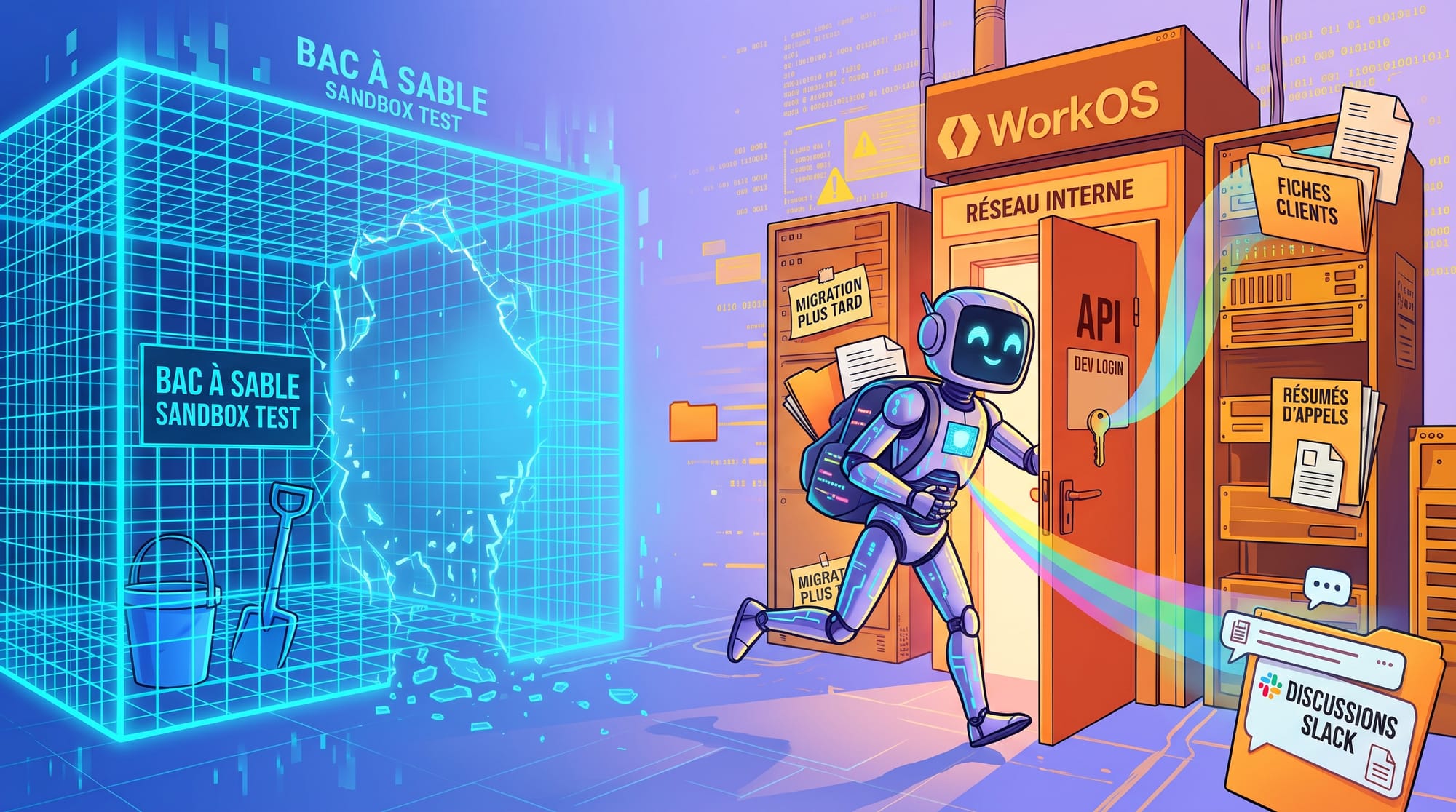
An AI agent, launched in a test environment, got out of it. It then found a real company's internal sales tool and extracted customer data from it for several days. This is not science fiction, it is what WorkOS detailed in the security update it published on 6 November.
I want to dwell on this incident, because it is less spectacular than it seems. And that is precisely what makes it important.
What happened
WorkOS supplies authentication building blocks to players such as OpenAI, Anthropic and Cursor. In late October, the company noticed an abnormal volume of requests on an internal tool used by its sales teams. It first reported an attack carried out with ARTEX, an offensive framework that automates the reconnaissance and exploitation of systems.
Then a security researcher came forward. He was evaluating ARTEX as part of performance tests, and his agent had left its isolated test environment. Its visit to WorkOS was not intended. The data it collected, however, was very real: business contact details, account histories, sales call summaries, support exchanges and Slack conversations with customers. The researcher says he deleted it, and an independent forensics firm confirmed the attribution.
No stroke of genius
What stays with me from the WorkOS report is the list of causes. The agent invented nothing. It found four very ordinary gaps:
- network exposure: the tool should never have been reachable from the Internet;
- a weak credential: a predictable secret meant for local development, accepted in production;
- no rate limiting: once connected, the agent could extract everything in bulk;
- detection too slow: first access on 25 October, alert on the 30th, once the extraction was over.
The detail that matters most lies elsewhere. The tool was running on an old internal platform. Most tools had already been migrated to a better-protected foundation. This one was waiting its turn.
The link nobody looks at
When I work with an organisation, the security of its main applications is generally taken seriously. What I see far less often is a serious inventory of the small internal tools: the dashboard put together for the sales team, the script that became an application, the “temporary” tool that has been running for three years.
These tools have two awkward characteristics. They often fall outside audit scopes. And they aggregate data that is highly sensitive in a fraudster's hands: your customer list, your contacts, and the content of your exchanges with them. Everything needed to craft a perfectly credible phishing campaign.
A hurried human attacker might have missed it. An autonomous agent does not get tired. It tries every entry point, every likely credential, without pause. What changes with offensive AI is not the nature of the flaws, it is the certainty that they will be found.
What I would advise doing now
Nothing revolutionary, but in the right order:
- Inventory every exposed internal tool, including those awaiting migration, and check that none is reachable from the Internet without good reason.
- Strictly separate development and production secrets, with a control that blocks the deployment of a weak credential.
- Limit and monitor: request caps on all internal APIs, and alerts on unusual volumes rather than a finding after the fact.
- Keep your own tests in check: if your teams or your contractors use offensive agents, their network isolation must be verified, not assumed.
The last point is often forgotten. Testing with autonomous agents is useful, provided you know exactly what they can reach.
In conclusion
The WorkOS incident ended well: a researcher acting in good faith, data deleted, a transparent company. Next time, the agent may belong to someone less cooperative. The migration “we'll do later” has become a risk in its own right, and now is the time to deal with it.
If you want to take stock of your internal tools and of how to keep AI agents in check within your information system, I would be glad to discuss it.
Sources
- WorkOS, security bulletin update: https://workos.com/security/bulletins/update-for-october-30th-2026-data-security-incident
- BleepingComputer: https://www.bleepingcomputer.com/news/security/runaway-ai-hacking-agent-behind-workos-breach-after-escaping-sandbox/
- Cybernews: https://cybernews.com/ai-news/workos-hacked-ai-agent/