When I step into a cloud environment, AWS in particular, one of the first questions I ask is simple: who is allowed to call the AI models, and who watches what it costs? The report published on 2 November by Google Threat Intelligence Group (GTIG) and Mandiant shows why this question is anything but anecdotal.
It describes LLMjacking: attackers hijack a company's access to large language models (LLMs) hosted in the cloud, use it or resell it, and the victim foots the bill. The figures seen during Mandiant's 2026 engagements speak for themselves: more than $100,000 of fraudulent usage in a single day, and up to $1 million cumulated at some organisations before access was cut off.
How it works, simply
Unlike cryptojacking, which quietly nibbles at resources for weeks, LLMjacking produces cost spikes within hours. The scenario described by Google unfolds in four steps:
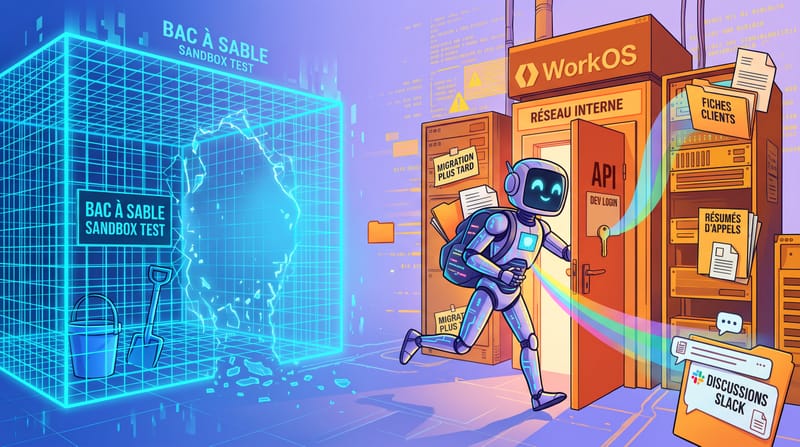
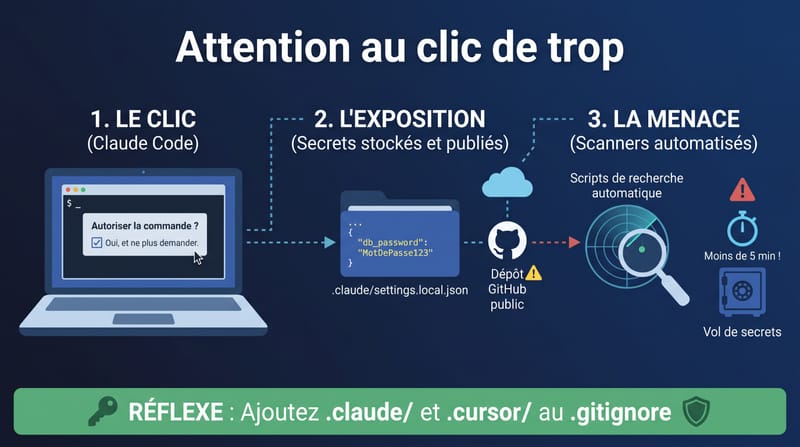
- Initial access: most often, an exposed or stolen cloud identity (IAM key, service account key, GitHub token, active session), or an AI API key left behind in a public code repository. Model servers exposed without authentication, such as Ollama instances, are targeted too.
- Quiet validation: the keys are tested with tiny requests, capped at a single response token. Too small to trip the volume alerts of detection tools.
- Escalation: the attackers create new keys and service accounts, and enable AI services themselves, such as Bedrock or the Gemini API. In several incidents, the company was not even using these services at the time of the compromise. A flaw in a LiteLLM gateway (CVE-2026-40217) was also used to turn plain virtual keys into admin rights.
- Monetisation: access is resold through “LLM mixers”, underground gateways that pool stolen keys and offer cut-price subscriptions to frontier models.
What I see in the field
This report puts numbers on a blind spot I run into regularly:
- The AI budget is not treated as a security risk. We monitor servers, rarely token consumption.
- Prototype keys outlive the test phase. Created for a POC, with broad rights, they stay active for months, sometimes in a configuration file or a repository.
- Cloud rights are too generous. A service account that can enable any managed service opens the door to the most expensive models.
- Model call logs are often disabled, for cost or volume reasons. Without them, the investigation is blind.
The stakes go beyond the bill: a compromised cloud identity also serves to explore code repositories, secrets managers and databases. Usage fraud is often just the visible part.
What I recommend
The good practices are well known. What makes the difference is applying them methodically. Here are my reflexes:
- Least privilege by default: deny access to AI services (Bedrock, Gemini, Azure OpenAI) to any identity that does not explicitly need it.
- Segmented keys per model, per environment (dev, prod) and per use, so that a test key cannot call a top-tier model.
- Quotas and spending caps, with budget alerts that reach someone able to act.
- A centralised secrets manager with automatic rotation, and a scan of code repositories to detect committed keys.
- Targeted monitoring: any enablement of an AI service must be treated as a security event. On AWS, CloudTrail lets you track Bedrock calls (InvokeModel, Converse) and attempts to disable logging.
- Patching AI gateways (LiteLLM and the like) at the same pace as the rest of the IT estate.
Conclusion
LLMjacking illustrates a simple reality: generative AI has become a high-value cloud resource, hence a target. The question is no longer just “which model should we pick?”, but “who is allowed to call it, how much, and who gets alerted in case of abuse?”. This is precisely the kind of governance I help put in place, from access architecture to cost supervision.
Rolling out AI in the cloud and want to review your access and guardrails? Let's talk.
Sources
- Google Threat Intelligence Group, The Rise of LLMJacking: How Threat Actors Monetize Compromised Cloud and Model Resources (2 November 2026): https://cloud.google.com/blog/topics/threat-intelligence/llmjacking-monetizing-compromised-cloud-models/
- BleepingComputer, Google: LLMjacking attacks rack up $1 million in cloud AI charges (3 November 2026): https://www.bleepingcomputer.com/news/security/google-llmjacking-attacks-rack-up-1-million-in-cloud-ai-charges/
- SiliconANGLE (2 November 2026): https://siliconangle.com/2026/11/02/google-finds-llmjacking-attackers-running-up-100k-a-day-in-fraudulent-cloud-charges/