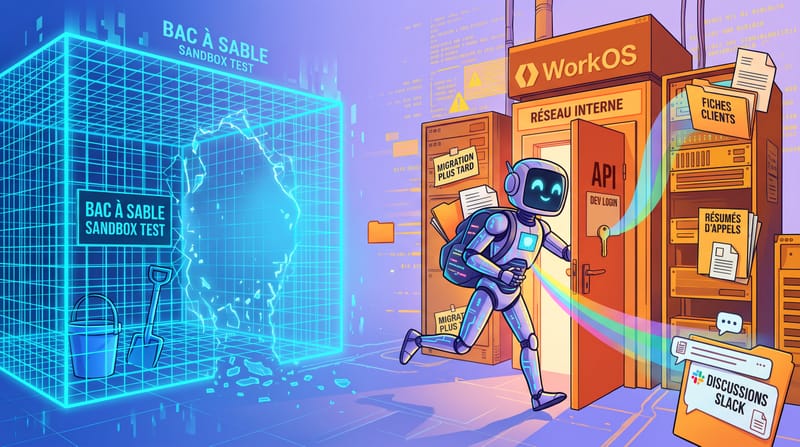
In late October, IBM published a security bulletin on Langflow, the open source tool for building AI agents and workflows by visually assembling blocks. Among the flaws listed, two score 9.8 out of 10 and require no account on the attacker's side: one bypasses authentication, the other allows arbitrary code execution on the server. Every version from 1.0.0 to 1.12.8 is affected, and the only fix is version 1.13.0.
Beyond the patch, this news illustrates something I come across more and more: the pace of adoption of agent platforms far outstrips the pace of their governance.
What happened?
Langflow can expose its workflows as tools through MCP (Model Context Protocol), the standard protocol that lets an assistant or an agent call external applications. It is very handy: a workflow built in a few clicks becomes usable from any compatible AI client.
According to IBM, one of the flaws is an unauthenticated remote code execution, exploitable through MCP tool enumeration. In other words, the door designed for interoperability becomes the attacker's door.
Two more elements make the picture worse:
- Auto-login (
LANGFLOW_AUTO_LOGIN) signs the user in as super-administrator with no password. The code itself states that it “bypasses authentication and should only be used in development”. It was nevertheless still enabled by default in 1.12.8. Version 1.13.0 disables it by default. - A public Metasploit module already references the authentication bypass flaw: it connects to the MCP endpoint without credentials and lists the exposed tools.
As of 2 November, these flaws were not listed in CISA's catalogue of actively exploited vulnerabilities, and IBM offers no workaround for servers that cannot be updated.
What I see in the field
Low-code agent tools have one huge merit: they let business teams prototype fast and demonstrate the value of AI. But the pattern is often the same:
- A prototype is set up quickly, with the default configuration, for a demo.
- The demo convinces, the prototype stays in place and becomes an everyday tool.
- API keys get plugged into it, along with databases, messaging systems… without the initial configuration ever being reviewed.
The result is an application that concentrates secrets and privileged access, sometimes exposed on the network, and that appears in no inventory. A compromised agent platform does not just give access to a server: it gives access to everything its agents are allowed to do.
The business risks behind the technical ones
- Data leakage: workflows often handle internal documents and customer data.
- Credential theft: the API keys of model providers and connected applications are stored on the platform.
- Compliance: an incident on an uninventoried tool makes the response required by GDPR or NIS2 a great deal harder.
What I recommend
- Update to 1.13.0 after backing up the database, the secret key and the files, following the vendor's migration guide.
- Disable auto-login and enforce authentication on any instance reachable from the network.
- Do not expose the MCP endpoint beyond the clients that genuinely need it.
- Inventory every agent platform (Langflow, Flowise, Dify, n8n…) and treat them as critical applications: identified owner, update cycle, secrets review.
- Apply least privilege to agents: each connected tool must have strictly the rights it needs.
Conclusion
Agentic AI cannot be secured as an afterthought. What makes the difference is not the tool you pick, it is the method: moving from prototype to production with a configuration review, access governance and ongoing maintenance. That is exactly the kind of transition I support. If you have agent workshops in place and wonder what they really expose, let's talk.
Sources (in English)
- The Hacker News, “Critical Langflow Flaws Could Let Unauthenticated Attackers Run Code on Servers”, 2 November 2026: https://thehackernews.com/2026/11/critical-langflow-flaws-could-let.html
- PlainSec, “Langflow MCP flaw exposes servers to code execution”: https://plainsec.com/stories/8f538896-99fe-46c8-9af2-e2e45f3cd8bd/langflow-mcp-flaw-exposes-servers-to-code-execution