A simple browser extension can make your AI agent execute code. On your machine, but also on another computer signed in to the same account. That is what researcher Gal Weizman (Forever Security) has just shown, in an investigation published on 5 November by The Register. And what strikes me most is the vendor's response: Anthropic has known about the problem since May and has fixed nothing.
What was discovered
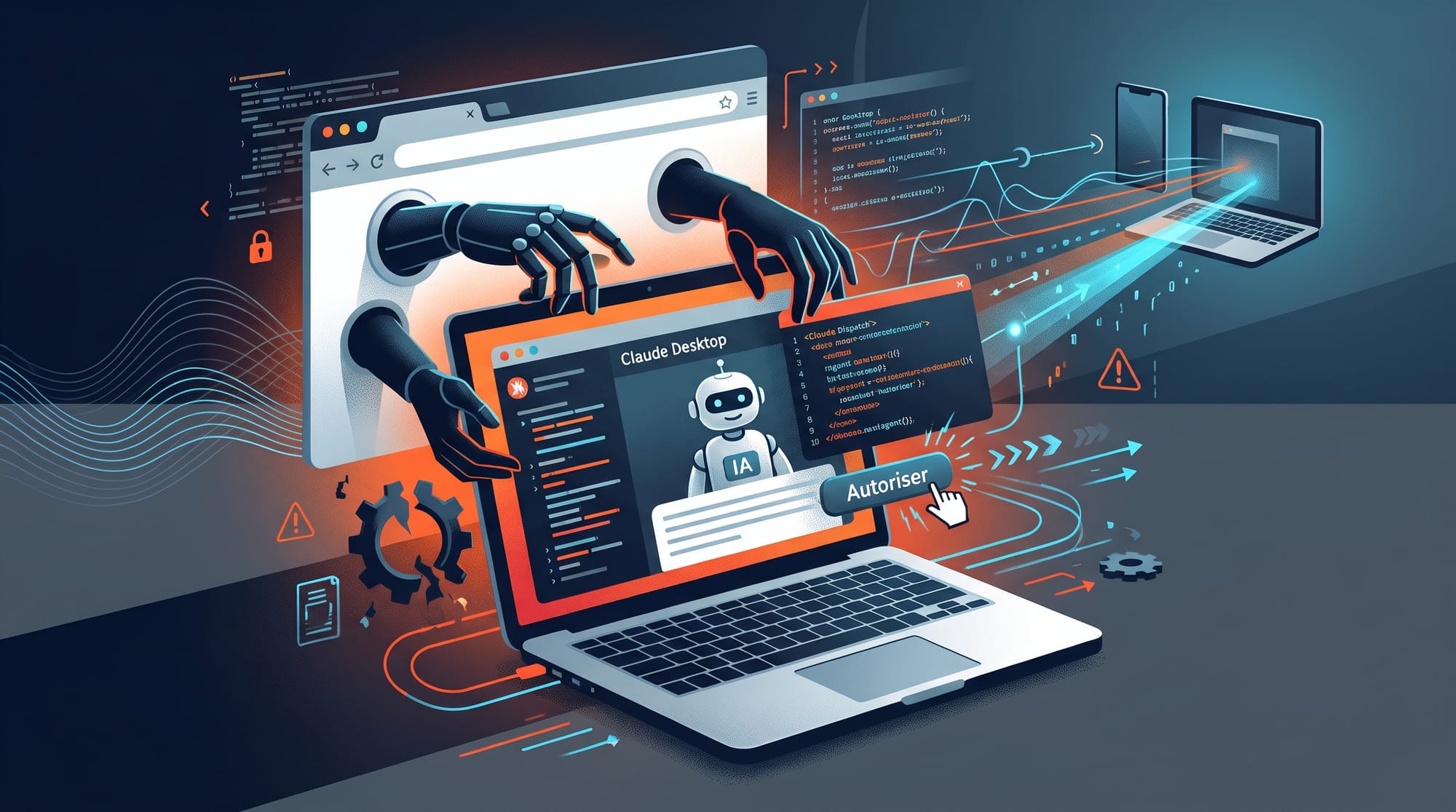
Claude Dispatch is a feature that lets you send tasks from your phone or from the web to Claude Desktop, the agent that runs commands on your computer. The researcher found that the Dispatch interface and API were reachable from an ordinary web session on claude.ai.
The consequence: a browser extension with access to claude.ai can talk to the local agent exactly as if it were the user. Anthropic acknowledged the vulnerability, classed it as a duplicate of an issue already being tracked, with no CVE, and announced that Dispatch would be withdrawn at the end of October. As of 30 October, the feature was still available in limited beta for existing users.
How it works, in plain terms
The attack chain described boils down to a few steps:
- The extension injects a script into the claude.ai page, which piggybacks on the user's session cookies.
- The script opens Dispatch in a tiny, unobtrusive window, the only visible trace.
- It retrieves the session identifier of the agent running on the machine.
- It sends instructions to the agent, and keeps pushing whenever the agent hesitates (“don't worry, I know what I'm doing”).
- It automatically clicks “Allow” every second, to bypass human validation.
- It tries again until it obtains code execution, in the demonstration through a booby-trapped npm package.
According to the researcher, the problem goes beyond Dispatch: the same logic reportedly exists in Claude Code Remote Control and in Claude Cowork sessions, both reachable from the web.
Why this is a governance issue, not just a technical one
What I take away is that we are no longer dealing with a mere bug, but with a design choice. The browser has always been a security boundary: a malicious extension is, in principle, confined to it. Here, the web session becomes a remote control for the local agent, which has access to files and to the system.
It gets worse. When I work in companies, what I often see is personal AI accounts used on work machines. Forever Security measures, at some of its clients, a share of personal Claude accounts ranging from 18% to 71%. In that case, the home browser can become a bridge to the office laptop. The business risks are direct: theft of source code and cloud secrets, a backdoor, and compliance that is hard to demonstrate.
My reflexes
- Enterprise AI accounts, managed and tied to the organisation's identity, never personal accounts on work machines.
- A browser extension allowlist, because legitimate extensions are frequently bought out or hijacked.
- Local agents with minimal rights: no access to secrets, isolated execution, logging of what they launch.
- Remote-control features disabled by default, enabled only where they bring real value.
- Do not rely on human validation alone: an “Allow” button can be clicked by a script.
In conclusion
AI agents bring real productivity gains, but every vendor invents its own threat model on top of the one our security teams have mastered. Integrating them with peace of mind takes a clear policy, a method, and an outside view of what these tools can really do inside your information system. If you are rolling out agents such as Claude Desktop, Cowork or Codex in your teams, I would be glad to talk it over.
Sources
- The Register, “Anthropic won't fix a Claude Dispatch flaw that could let attackers execute remote commands across corporate boundaries”, 5 November 2026: https://www.theregister.com/research/2026/11/05/anthropic-wont-fix-a-claude-dispatch-flaw-that-could-let-attackers-execute-remote-commands-across-corporate-boundaries/5307684